
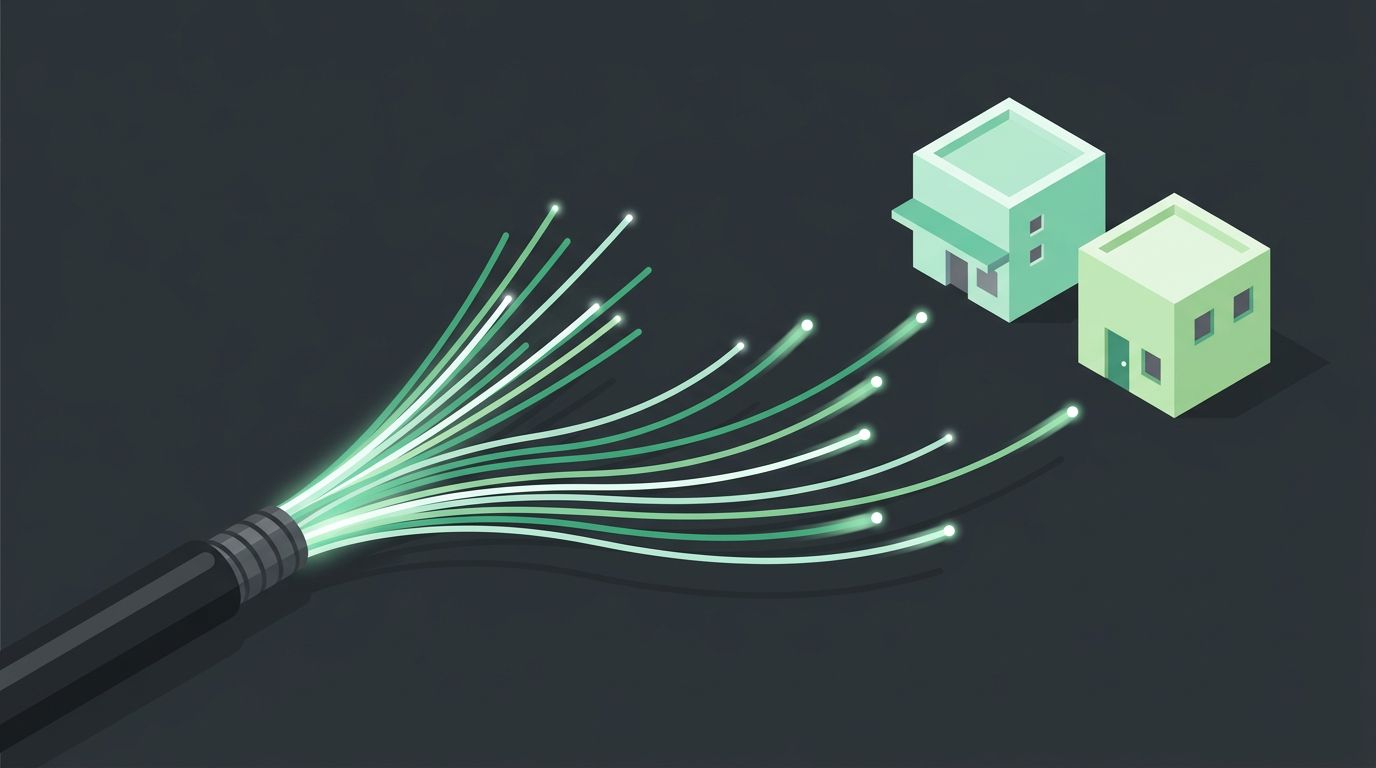
When a network has to reach another building, a gatehouse, a clubhouse, or the far end of a large warehouse, copper runs out of distance. Fiber optic cable carries data with light instead of electricity, so it goes much farther, carries far more bandwidth, and isn’t affected by electrical interference or lightning-induced surges between buildings.
Single-mode and multimode
| Type | Core | Typical reach at 10 Gbps | Common use |
|---|---|---|---|
| Single-mode (OS2) | 9 microns | 10 kilometers and more | Between buildings, campuses, and long runs |
| Multimode (OM3) | 50 microns | About 300 meters | Inside a building or data room |
| Multimode (OM4) | 50 microns | About 400 meters | Inside a building or data room |
Older multimode types, OM1 and OM2, are still found in existing buildings but aren’t used for new work. Single-mode used to cost more because of its optics; today the difference is small, and single-mode leaves the most room to grow.
Indoor, outdoor, and armored cable
- Indoor cable is tight-buffered and carries a riser or plenum rating, like copper.
- Outdoor cable is built to block water and resist sunlight, for runs in conduit between buildings.
- Indoor/outdoor cable is rated for both, so one run can go from a building’s rack to a gatehouse without a transition splice.
- Armored cable adds a metal layer that protects against crushing and rodents where the cable is buried or exposed.
Connectors
LC is the most common connector today: it’s small and fits the SFP modules in most switches. SC is larger and still common in older equipment. MPO connectors carry many fibers at once in high-density data rooms.
Spliced ends instead of field tipping
A fiber run can be finished two ways. Field tipping means installing connectors on the cable by hand on site, which depends heavily on conditions and technique. Fusion splicing joins factory-made, pre-terminated ends (pigtails) to the cable with heat, so the connector itself was built and polished in a factory. The result is lower signal loss and a more reliable link.
Our standard
- Spliced, engineered ends. We fusion-splice factory-terminated ends to every run instead of tipping connectors by hand, so connector quality isn’t left to chance.
- Single-mode (OS2) between buildings, sized with spare strands for future growth.
- LC connectors to match today’s switches and SFP modules.
- Outdoor-rated cable in conduit between buildings, with armored cable where a run is exposed or at risk from rodents.
- Tested, labeled, and documented at both ends.
Connecting buildings, a gatehouse, or a clubhouse? See our structured cabling services.