
Every camera, phone, access point, and computer on your network depends on the cable behind the wall. Copper cabling usually outlasts several generations of equipment, so the category you choose today decides what your network can do for the next ten to fifteen years.
CAT5e vs. CAT6 vs. CAT6A
| Category | Bandwidth | Speed at 100 meters | Best for |
|---|---|---|---|
| CAT5e | 100 MHz | 1 Gbps (2.5 Gbps on many runs) | Older installs; not recommended for new work |
| CAT6 | 250 MHz | 1 Gbps, up to 5 Gbps; 10 Gbps on shorter runs (roughly 55 meters) | Desks, phones, cameras, and most everyday drops |
| CAT6A | 500 MHz | 10 Gbps for the full 100 meters | WiFi 6 and WiFi 7 access points, high-power PoE devices, and switch uplinks |
Why CAT6 instead of CAT5e
- More headroom. CAT6 carries more than twice the bandwidth of CAT5e, with less crosstalk between pairs.
- Ready for faster gear. Today’s switches and access points increasingly run at 2.5 and 5 Gbps, and CAT6 handles those speeds comfortably.
- About the same installed cost. Most of the cost of a cable run is labor, so the step up from CAT5e adds very little to a project.
Why there are different kinds of CAT6
CAT6 and CAT6A
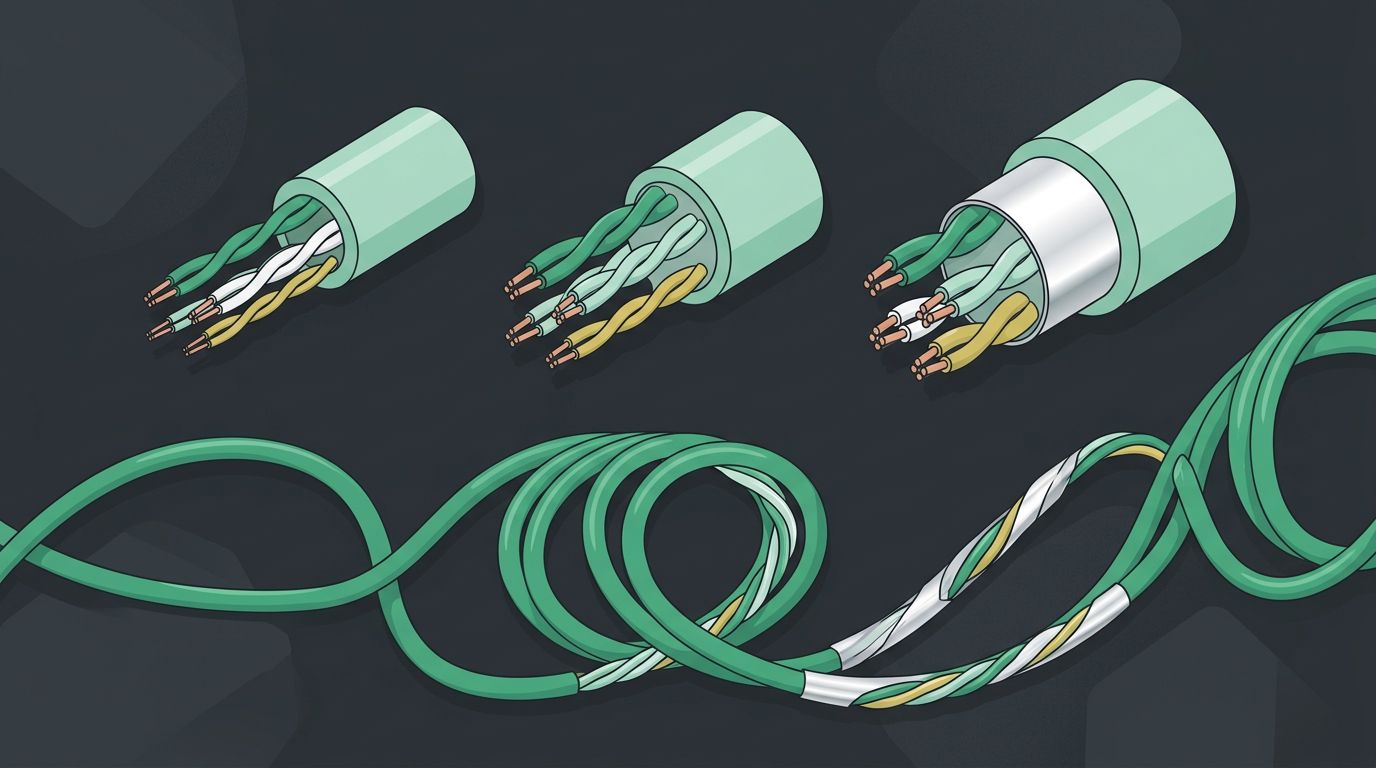
CAT6A (“augmented”) is built to carry 10 Gbps for the full 100-meter channel. It’s thicker, with tighter twists and more separation between pairs, so it holds up better against interference from neighboring cables and handles the heat of high-power PoE devices.
Unshielded and shielded
Most offices use unshielded twisted pair (UTP). Shielded cable (often labeled F/UTP or S/FTP) adds foil around the pairs for sites with heavy electrical noise, such as manufacturing floors, but it only works when it’s bonded and grounded correctly from end to end.
Plenum and riser jackets
The jacket rating is about fire safety. Riser cable (CMR) is rated for vertical runs between floors. Plenum cable (CMP) is required in air-handling spaces, such as many drop ceilings, because it produces less smoke if it burns. Outdoor and direct-burial runs need cable rated for water and sunlight.
Solid and stranded
Solid copper conductors are made for the permanent runs inside walls and ceilings. Stranded cable is more flexible and belongs in patch cords at the rack and the desk.
Pure copper, not copper-clad aluminum
Low-cost “CAT6” made from copper-clad aluminum (CCA) doesn’t meet industry standards, runs hotter with PoE, and breaks more easily. It’s one of the most common problems found in cheap installations.
Our standard
- Windy City Wire cable only. Every copper run we install uses Windy City Wire.
- CAT6 as the minimum for new drops, with CAT6A for WiFi access points, high-power PoE devices, and 10 Gbps links.
- Solid, pure-copper conductors for every permanent run, never copper-clad aluminum.
- The right jacket for the space: plenum-rated where code requires it, riser between floors, and outdoor-rated cable outside.
- Tested, labeled, and documented. Every run is tested and labeled at both ends, and you get the documentation at hand-off.
Planning a new office, a remodel, or a cabling cleanup? See our structured cabling services.